


On this page
Guidelines on Customer Due Diligence Regarding the Beneficial Owner in Real Estate Brokerage Services
1447/10/08
1447/10/07
Active
Guidelines
Introduction
This Guideline aims to assist real estate brokers in understanding their obligations related to identifying and verifying beneficial owners in accordance with the Anti-Money Laundering Law and the Law on Combating Terrorism Crimes and its Financing in the Kingdom of Saudi Arabia. It also aims to serve as a practical reference for real estate brokers on how to effectively implement Customer Due Diligence requirements related to the beneficial owner. This Guideline takes into account the standards and guidance issued by the Financial Action Task Force (FATF) and best practices in the sector. This Guideline is not exhaustive of all cases. It also does not restrict the measures that a real estate broker may take in fulfilling its regulatory obligations within the existing legal framework in the Kingdom.
A number of reports emphasize the risks associated with legal persons and endowments in relation to money laundering and terrorist financing, for example: companies, endowments, and associations and non-profit organizations, which, despite their often-legitimate economic role, may in some cases be exploited within complex schemes to conceal the identity of the beneficial owner or to conceal assets or the reasons for their ownership.
One of the most common methods of such exploitation is the use of legal persons and endowments to conceal the identity of the actual beneficial owner and control over accounts. The establishment of a legal entity (a legal person) or an endowment may allow a criminal to create a layer separating themselves from their illicit assets, making them difficult to detect and hindering any criminal investigation that may target them. Although many legal entities in their various forms operate legitimately, many of the practices described in this Guideline can be exploited to conceal illicit funds and facilitate money laundering, terrorist financing, and the proliferation of weapons.
Concept of the Beneficial Owner
1. Article (15/1) of the Anti-Money Laundering Law issued by Royal Decree No. (M/20) dated 05.02.1439H corresponding to 25.10.2017AD defined the beneficial owner as: "the natural person who ultimately owns or exercises effective control, directly or indirectly, over the customer or the natural person on whose behalf the transaction is being conducted, or over financial institutions, designated non-financial businesses and professions, non-profit organizations, or any other legal person."
2. The Implementing Regulations of the Anti-Money Laundering Law, in paragraph (c) of Article (7/2), stipulate the requirement that Customer Due Diligence measures include identifying the identity of the beneficial owner, and taking reasonable measures to verify it using documents, data, or information from a reliable and independent source, such that financial institutions and designated non-financial businesses and professions are satisfied that they know the beneficial owner, as follows:
a) The identity of the natural person who owns or controls 25% or more of the shares of the legal person shall be identified, and reasonable measures shall be taken to verify their identity.
b) In cases where a controlling ownership interest is not available as set out in the preceding paragraph, or where it is suspected that the holder of the controlling interest is not the beneficial owner, the identity of the natural person who exercises control over the legal person through other means shall be identified. Alternatively, as a last resort, the identity of the natural person holding a senior management position may be identified and verified.
c) With respect to legal arrangements, the real estate broker shall identify the identity of the settlor, trustee, beneficiaries or classes of beneficiaries, and any other natural person who exercises ultimate effective control over the legal arrangement or holds positions equivalent to those of other types of legal arrangements, and shall take reasonable measures to verify such identity.
3. The real estate broker shall differentiate between the legal owner and the beneficial owner. The legal owner means the natural or legal person who owns the legal person, while the definition of the beneficial owner extends beyond legal ownership to include the concept of ownership and ultimate effective control. Identifying the shareholders of the entity alone does not always reveal the beneficial owners, as shareholders may be other legal entities.
4. It is important to emphasize that the beneficial owner may be: a) a natural person (and not a legal person) who actually owns and benefits from the capital or assets of the legal entity; b) persons who exercise effective control over that entity (whether or not they hold formal positions within that legal entity); c) persons legally authorized to manage that entity, whether they are persons (natural or legal); d) persons who control the legal entity based on the type of shares they own, regardless of their ownership percentage; and e) persons who control the entity who are not shareholders.
Obligations related to identifying and verifying beneficial owners
1. Criminal organizations often attempt to conceal the true beneficial owner and controller, which makes the process of identifying, recognizing, and verifying them difficult. The responsibility for identifying the beneficial owner rests with the real estate broker when providing the service, with the emphasis that the beneficial owner is always a natural person and not a legal person. A legal entity or endowment may have more than one beneficial owner, which necessitates identifying all of them, as well as recognizing and verifying their identities.
2. The primary task is to identify and verify the beneficial ownership arrangements of customers, and understanding who the beneficial owners are helps in making informed decisions regarding the risks associated with money laundering, terrorist financing, and the financing of proliferation of weapons. This includes the real estate broker’s obligation to:
1) Understanding the customer’s ownership structure.
2) Identifying the beneficial owner.
3) Verifying the identity of the beneficial owner.
3. The real estate broker shall identify the customer’s ownership structure as a first step, as the ownership structure is a key element in guiding the selection of appropriate customer due diligence measures. It also provides indicators of the complexity of the customer’s ownership arrangements.
4. It is important to know the beneficial owner of the customer (legal person or endowment) with whom the real estate broker is dealing, whether it is owned directly or indirectly, or whether the ownership chain involves legal persons or complex legal arrangements. This initial assessment enables the real estate broker to accurately classify the customer’s risk level.
5. As a second step, and for the purpose of identifying the beneficial owner, the real estate broker shall begin by determining whether there is any natural person who owns the customer (legal person or endowment). If no direct or indirect ownership is identified, the broker shall identify the person who controls 25% or more of the shares or voting rights of the legal person.
6. The real estate broker may, in accordance with a risk-based approach, not apply the requirement to identify the beneficial owner to companies whose securities are traded on a regulated market, and which are subject to disclosure obligations in accordance with the laws of the Kingdom or equivalent international standards that ensure sufficient transparency of information relating to ownership of capital.
7. In summary, the real estate broker shall do the following:
a. Identifying the natural persons who ultimately hold a controlling ownership interest in the legal person, namely identifying the natural persons who own 25% or more of the share capital.
b. In the event of doubt as to whether the controlling persons are the beneficial owners, or if no natural person exercises control through ownership, the natural person who exercises control by any other available legal means shall be identified.
c. In the event that no natural person is identified, real estate brokers shall identify and take reasonable measures to verify the identity of the relevant natural person holding an executive position or occupying senior management roles.
Direct and indirect ownership for identifying the beneficial owner
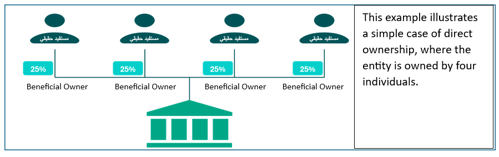
1. The first step for the real estate broker in identifying the beneficial owner is to determine whether the customer (the legal entity) is owned, directly or indirectly, by one or more natural persons.
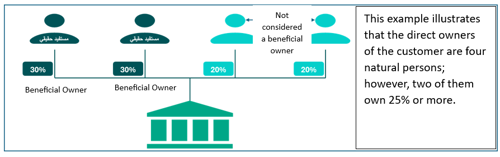
2. Ownership may be divided into shares of 25% or less; however, the relationships between the parties may grant an individual aggregate ownership in the customer exceeding 25%. This includes individuals who directly or indirectly hold a specified percentage of ownership in the legal entity.
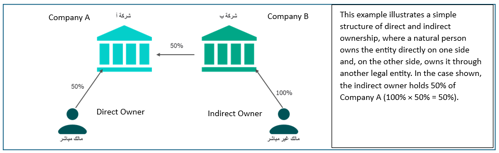
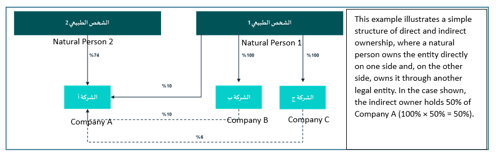
3. The real estate broker shall calculate the ownership percentage as part of the ownership test, and shall determine the percentage of capital owned across multiple successive levels of indirect ownership, whereby the total percentage of capital owned by each individual is the mathematical product of these different indirect ownership percentages, resulting in a weighted calculation of the shareholding percentages.
1st Example
2nd Example
3rd Example
4th Example - Aggregate ownership
Concept of Control
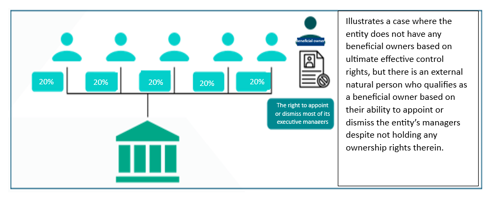
1- The real estate broker shall identify a natural person who exercises ultimate control over the customer when no direct or indirect ownership representing 25% or more of the shares of the legal entity is identified.
2- The concept of control refers to the ability to make and enforce key decisions within the legal person or legal arrangement, and a distinction shall be made between acting on behalf of the customer and possessing actual control over it, which contributes to understanding the management and governance structure in identifying individuals who exercise actual control. When identifying individuals who exercise actual control over non-individual customers, consideration shall be given to individuals who can control the customer and appoint or dismiss senior management, those who hold 25% or more of the voting rights, and individuals in senior executive positions (such as: the Chief Executive Officer) and trustees where applicable. This comprehensive comparison ensures an accurate understanding of the beneficial owner who exercises ultimate control.
3- The following cases are examples of natural persons who may be considered beneficial owners on the basis that they are the actual owners/ controllers of the legal person, either through their interests, or through the positions they hold within the legal person, or through other means, as follows:
a) Shareholders who exercise control individually or together with other shareholders through contracts, agreements, relationships, intermediaries within the entity, or other means: this approach focuses on shareholders who possess such control, whether individually or collectively, through contracts, agreements, relationships, intermediaries, or layered entities, and includes indirect control that may extend beyond legal ownership through corporate entities and nominee arrangements.
b) Control through personal relationships: this includes individuals who control a legal entity as a result of their personal relationships with the individuals who own the entity or who have influence within it.
c) Control without ownership: natural persons may exercise control without ownership through contributing to the financing of the project or due to close family relationships or historical or contractual ties with the entity, and the existence of control may be presumed even if it is not actually exercised; for example: benefiting from assets owned by the legal entity. Indirect control may also be established through shareholder agreements, the exercise of dominant influence, or the ability to appoint or dismiss senior management, and shareholders may cooperate to enhance control through formal or informal agreements, including the use of nominee shareholders.
d) Control through the positions held: identifying the individuals responsible for strategic decisions that affect the entity’s practices or direction, such as executives, is important; executives may control the entity, or they may not actually control it, and their information may be limited if there are nominee arrangements representing unidentified interests.
e) Executive control: natural persons have significant executive control over day-to-day affairs through their senior management positions, such as the Chief Executive Officer, the Chief Financial Officer, the Managing Director, or the President; these individuals have significant authority over the relationships and ongoing financial affairs of the legal entity, including dealings with designated non-financial businesses and professions that manage accounts on behalf of the entity.
f) Trustees (where applicable).
The following diagram illustrates the concepts of control on the basis of which a natural person shall be considered a beneficial owner.
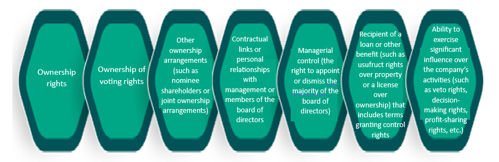
Source: Organization for Economic Co-operation and Development, Framework for Building Effective Beneficial Ownership Systems: A Joint Toolkit of the Global Forum and the World Bank Group
5th Example
Verification of the identity of the beneficial owner
1- 1- Real estate brokers shall consider whether the information provided regarding the beneficial owner is sufficient to establish their identity and that it is based on documents, data, or information from independent and reliable sources that meet regulatory requirements.
2- Sufficient information to establish the identity of the beneficial owner includes, for example, the full name, nationality or nationalities, full date and place of birth, residential address, identification details for a citizen or identification document (resident ID) or passport in full, the type of document and its date of issuance and expiry, or the full name of their representative, their nationality, date and place of birth, residential address, identification number and its date of issuance and expiry, mobile phone number, and email address—if any.
3- The accuracy of the information provided regarding the beneficial owner and ownership information shall be verified to ensure its correctness. The verification process shall be based on a risk-based approach, and a simplified company structure shall be provided to verify the validity and integrity of the submitted documents. More complex ownership structures require additional reliable sources and competent authorities to verify the accuracy of the information provided, including examining the accuracy of documents to determine the status of beneficial owners. Simple corporate structures require verification that the submitted documents are valid and current, whereas more complex ownership structures require additional sources to verify the information provided, including greater focus on the types of documents and the validity of the documents submitted to evidence the status of the beneficial owner (such as shareholder documents and other agreements that grant natural persons control over the legal entity or legal arrangement).
4- For complex ownership structures, documents that may assist in verifying beneficial ownership may include, but are not limited to: the company’s articles of incorporation, the commercial register showing ownership and/ or the shareholder register indicating ownership percentages, the trust deed, the partnership agreement, the certificate of registration, the articles of association—if any—of the legal entity or legal arrangement, any shareholder agreements showing who exercises actual control, any shareholder agreements indicating that a natural person exercises control over the shares of more than one shareholder, documents evidencing that a natural person is able to control a legal person, documents evidencing that a natural person has the authority to appoint or dismiss senior management, documents (for example: an employment contract) indicating that a manager or employee can influence a legal person, or documents evidencing that a natural person has control over a legal entity or legal arrangement.
5- This list is not exhaustive, but rather illustrative, and the more complex or opaque the ownership structure is, the greater the need to take additional verification measures so that the real estate broker can determine who the beneficial owner is.
6- The table below illustrates examples of entities, types of beneficial owners, and the documents that shall be provided to identify and verify the beneficial owner:
Examples of beneficial owners by type of legal entity
|
Type of legal entity |
Type of beneficial owner |
Type of documents to identify and verify identity |
|
Companies of all forms |
- Natural persons who directly or indirectly own 25% or more of the shares or voting rights. - If the required percentage is not met, or there is doubt that the person owning that percentage exercises actual control, the beneficial owner shall be any natural person who exercises ultimate effective control over the company by any means, whether directly or indirectly. - If a natural person cannot be identified, the company’s manager, a member of its board of directors, or its president shall be considered the beneficial owner, as applicable. |
- Articles of incorporation. - Commercial registration certificate. - Company’s articles of association. - Beneficial owner register. |
|
Associations or non-profit institutions |
- A member of the board of directors of an association or a member of the board of trustees of an institution. - An executive officer of an association, institution, or entity holding senior management positions. - Any natural person not covered by the previous two categories who has the authority to appoint or dismiss the executive officer or senior management positions in the association or institution, or who directly or indirectly exercises control over the general activities of the association or institution. |
- Information of the association or institution. - Its legal form. - Address of its headquarters, registration number, classification, and the authority supervising it technically. - List of board of directors or board of trustees members and senior management positions. - The association’s or institution’s bylaws. - Beneficial owner information (name, identification number, place and date of birth, national address, contact details, the date on which they became a beneficial owner of the association or institution, and the reason for becoming a beneficial owner of the association or institution). |
|
Legal arrangement |
- The endowment founder (Waqif) if they exercise ultimate effective control over the endowment (Waqf). - The supervisor (Nazir). - Any other natural person who exercises ultimate effective control over the endowment. |
- Endowment deed (Sukuk al-Waqf) - Endowment registration certificate - Supervisory deed (Sukuk al-Nazara) - All official documents related to the endowment |
Continuous monitoring to identify beneficial owners
1- 1- In cases where real estate brokers engage in an ongoing relationship with the customer, the verification of the beneficial owner’s identity shall not be limited to the initial instance only. Continuous monitoring of the beneficial owner becomes increasingly important to ensure accurate identification of individuals who exercise actual control over or benefit from the entity, as the interests of the beneficial owner may change over time, particularly in complex structures where rights or control are distributed among multiple parties. In complex corporate structures, shares or control rights may be divided among different stakeholders and often exercised indirectly; new investors may take a significant role in the company, or current owners may transfer control, and such changes may occur frequently. Accordingly, real estate brokers shall conduct continuous review and monitoring of transactions to ensure that their understanding of the beneficial owner’s identity remains up to date and accurate.
2- Criminals often exploit complex ownership structures or use nominee names as a façade to conceal the actual beneficial owners of a legal person or legal arrangement, facilitating the execution of unlawful activities without detection. In the absence of continuous monitoring, such attempts to conceal the beneficial owner’s identity may go unnoticed, enabling illegal movement of funds. Through continuous monitoring of financial flows and reviewing changes in ownership structures, real estate brokers can identify and track unusual patterns, transfers to high-risk jurisdictions, or discrepancies between official records and actual activities, where early detection helps prevent misuse of the real estate sector for illicit activities.
3- In accordance with Financial Action Task Force (FATF) standards, real estate brokers shall adopt a risk-based approach when conducting customer due diligence, which includes the need for continuous monitoring. Legal persons and legal arrangements classified as high-risk shall undergo more frequent and detailed scrutiny, allowing brokers to adjust their customer due diligence measures based on the customer’s or beneficial owner’s updated risk profile, ensuring emerging risks are addressed promptly.
4- Furthermore, continuous monitoring is effective in mitigating money laundering and terrorist financing risks, as it enables real estate brokers to detect unusual or suspicious transactions, whether large transfers or a series of small transactions designed to evade detection (commonly known as "structuring"). This facilitates early investigation or reporting to the relevant financial intelligence authority, which may help prevent misuse of the financial system.
Related terms
|
Term |
Definition |
|
Association |
Non-profit association |
|
Institution |
Non-profit institution |
|
Endowment founder (Waqif) |
The natural or legal person who establishes the endowment (Waqif) |
|
Endowment supervisor (Nazir) |
The natural or legal person who assumes supervision of the endowment (Nazir) |
|
Companies (according to beneficial ownership rules) |
All companies subject to the provisions of the Companies Law, except joint-stock companies listed on the financial market |
